In everyday life, AI agents are evolving far beyond simple chatbots to become advanced research partners and personal life managers. The dominant trend in 2026 is the shift from reactive AI (responding to user prompts) to proactive AI, where agents autonomously perform tasks based on context and user behavior.
Modern AI agents not only understand natural language but also maintain long-term memory of user preferences, work history, and relationships – enabling highly personalized decision-making.
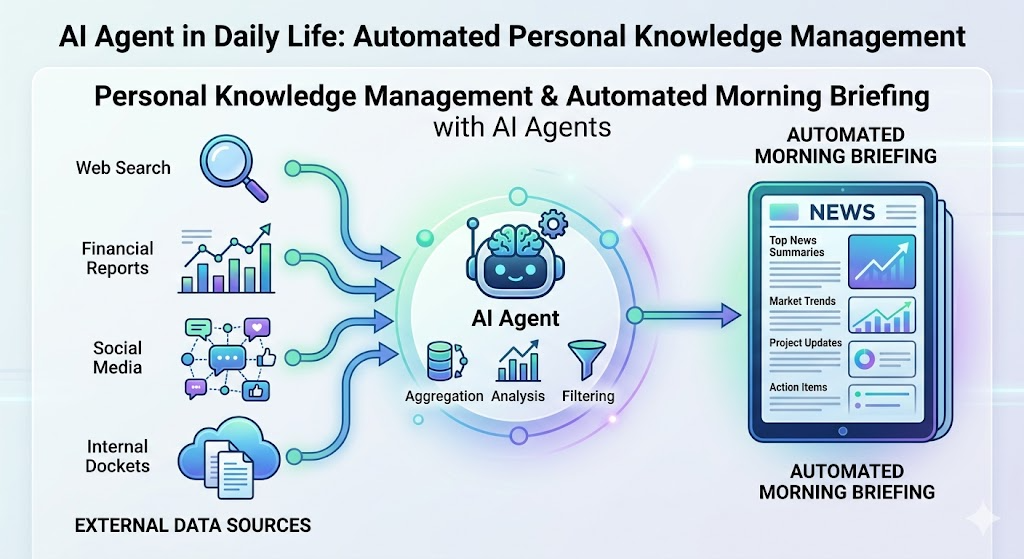
Personal Knowledge Management & Automated Daily Briefings
One of the most practical applications of AI agents is automated information synthesis.
Research agents can scan thousands of data sources – from web content and financial reports to social media discussions – to generate structured daily briefings.
Instead of spending hours doomscrolling, users receive curated insights delivered via email or cloud storage.
These systems often use multi-layer retrieval mechanisms and frameworks such as MCP (Model Context Protocol) to connect with local and proprietary data sources.
This effectively creates a “second brain,” where agents not only retrieve information but also connect new insights with existing knowledge.
For example, an agent can automatically enrich calendar events with contextual information from recent news, ensuring users are fully prepared for meetings without manual effort.
| Agent type | Function | Core Benefit | Example |
| Research Agent | Aggregates data from web, reports, social media | Saves 3–5 hours/day | Gemini deep research Grok/open AI research |
| Scheduling Meeting | Manages calendar and protects deep work time | Reduces conflicts | OpenClaw |
| Meeting Assistant | Transcribes and extracts action items | No missed tasks | Gemini (integrated in Google Meeting) |
| Personal Finance Agent | Tracks spending and suggests actions | Better financial decisions | B3 Agent |
The biggest difference in agents in 2026 is outcome ownership.
A scheduling agent, for example, no longer just displays events. It can take actions such as sending emails to decline unimportant invitations, or automatically finding free time slots to schedule workouts based on the user’s health goals.
This represents a shift from providing information to executing actions, turning AI into an active entity within each individual’s digital environment.
Outcome Ownership: From Assistant to Operator
In enterprises, AI agents are no longer experimental tools – they have become a new layer of the workforce. According to a 2026 report by Google Cloud, AI agents are fundamentally reshaping how employees work: shifting from executing repetitive tasks to focusing on higher-level strategic thinking, where humans act as managers of agent teams.
Organizations are shifting from “buying AI tools” to building AI workforces, integrating agent-driven workflows across business processes.
Business Process & Supply Chain Automation
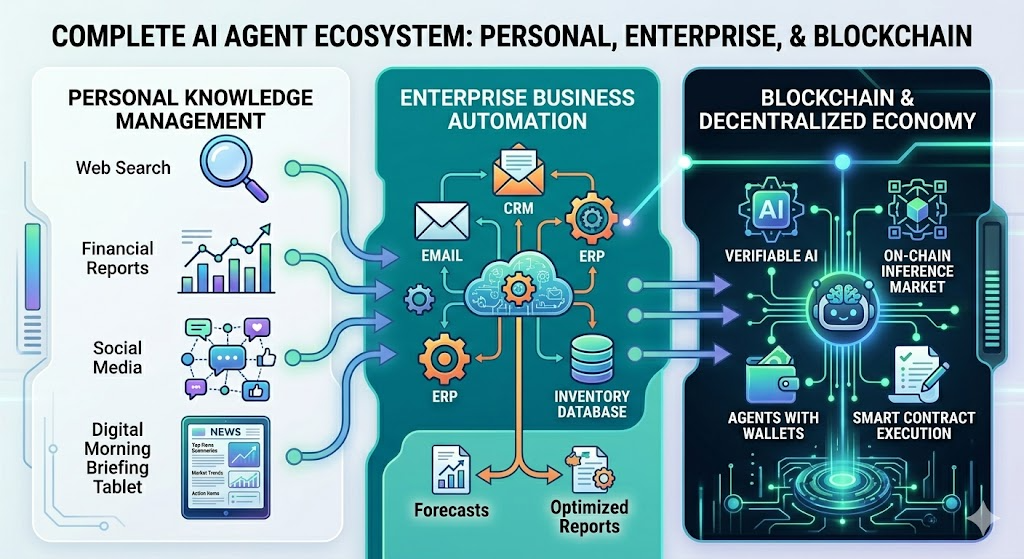
The power of AI agents in enterprises lies in their ability to connect fragmented systems (such as CRM, ERP, email, and databases) and execute end-to-end workflows without human intervention as a data bridge.
For example, in order management, an agent can automatically read customer emails, extract relevant information, check inventory in the ERP system, call APIs to calculate shipping costs, and send back a quotation – all within seconds. Danfoss has reported using AI agents to automate up to 80% of email-based transactional decisions, reducing customer response time from 42 hours to almost instant.
In supply chains, agents handle complex demand forecasting by analyzing historical sales data combined with external factors such as market trends and weather forecasts. Instead of relying on static reports, these agents can generate optimized procurement plans, automatically detect potential supply chain disruptions, and propose alternative solutions for managers.
This enables businesses to significantly reduce excess inventory and optimize operational costs while maintaining agility in a dynamic market environment.
Industry Applications
| Industry | Use Case | Impact |
| Finance | Fraud detection & claims processing | -40% false positives |
| Retail | Inventory & logistics optimization | -30–50% cost |
| Software | Coding agents for maintenance/testing | 86% adoption |
| Customer Service | AI concierge support | Personalized 24/7 |
Next-gen Business Intelligence
Traditional BI requires technical expertise.
AI agents democratize data access by allowing users to ask:
“Why did revenue drop 10% last month?”
The agent:
- Runs SQL queries
- Analyzes variables
- Returns visual insights
At Suzano, AI agents reduced data query time by 95% across 50,000 employees.
Agents also provide predictive insights, enabling real-time decision-making instead of waiting for monthly reports.
AI Agents in Blockchain: Intelligence Meets Trust
The convergence of AI and blockchain is creating a new paradigm:
The autonomous agent economy
AI provides reasoning and decision-making
Blockchain provides trust, execution, and ownership
AI Agents with Wallets
By 2026, AI agents can:
- Own crypto wallets
- Execute transactions autonomously
- Participate in DeFi and digital economies
Enabled by:
- Smart accounts (EIP-7702)
- Gas abstraction
Security mechanisms include:
- Spending limits
- Contract allowlists
- Audit logs
This allows individuals to deploy multiple agents that operate independently and generate passive income.
Verifiable AI & On-chain Inference
Traditional AI suffers from the “black box” problem.
Blockchain introduces verifiable AI:
- AI outputs are proven using ZK proofs
- On-chain inference marketplaces emerge
- Node operators stake assets to guarantee correctness
Protocols like EigenLayer enforce accountability through slashing mechanisms.
This enables AI to be trusted in high-stakes decisions such as lending, governance, and financial risk assessment.
| AI Blockchain Project | Agent Functionality | Technology Advantages |
| Fetch.ai ($FET) | Agents automatically search for and execute service transactions | Standardized multi-agent communication protocol |
| ai16z | Investment agents analyzing market sentiment | Optimizes on-chain trading based on community data |
| aixbt (Virtuals) | Agents analyzing trends and hot events | Leverages real-time data to predict price movements |
| Neur (Solana) | Smart interface for interacting with DeFi and NFTs | Smooth user experience through natural language |
| Swarms | Ecosystem for automation and multi-agent orchestration | Enables agents to collaborate on complex tasks |
On-Chain Inference Markets & Verifiable AI
A major limitation of traditional AI is its “black box” nature – users cannot be certain why an AI produces a given result or whether that result has been tampered with. Blockchain addresses this problem through Verifiable AI.
By 2026, we are seeing the rapid emergence of on-chain inference markets, where network nodes provide outputs from AI models (such as Llama or Qwen) and use ZK-proofs to verify the correctness of those inferences.
Protocols like EigenLayer enable node operators to stake assets as collateral to guarantee the reliability of AI services. If an AI agent produces incorrect or malicious outputs, the operator’s stake can be slashed, creating an economic security layer for AI-driven decisions – especially in critical use cases such as loan risk assessment or DAO governance.
Conclusion
AI agents are no longer just tools that respond to prompts – they’re evolving into active participants in how work gets done. Instead of waiting for instructions, modern agents can take initiative, execute tasks, and make decisions based on context, memory, and user behavior.
What used to be a support layer is gradually becoming part of the operational layer itself. In many cases, AI isn’t just assisting humans anymore – it’s working alongside them, and sometimes even replacing parts of the workflow entirely. This shift marks a new model where AI is not just a tool, but a real contributor to how systems and processes run.