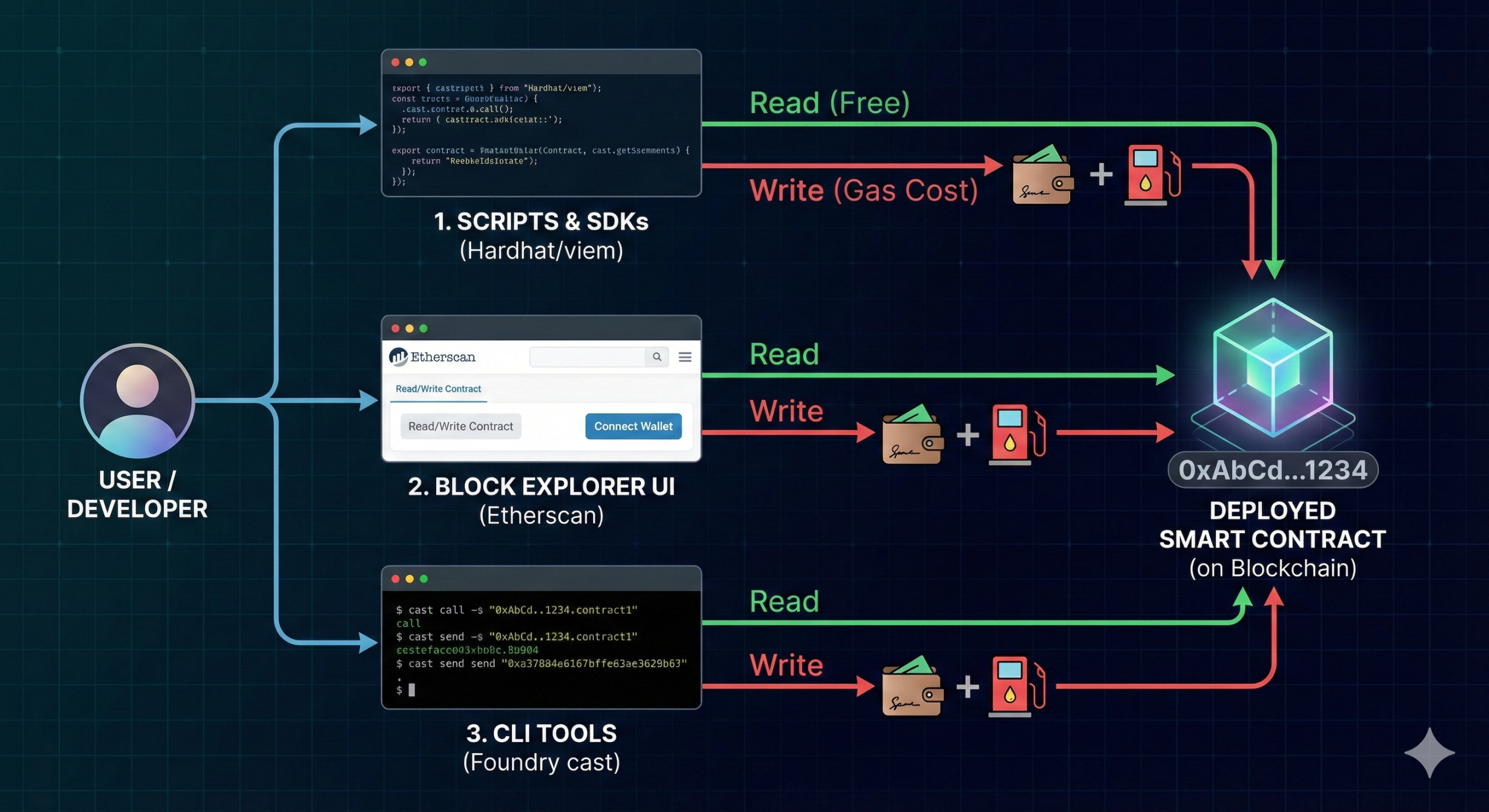

Before writing your first deploy command, you need to clearly understand where you are deploying and which tools you are using. A smart contract is not just a few lines of Solidity code – it exists within the broader EVM ecosystem, including node providers, wallets, block explorers, and development frameworks.
In this first part of the series, we will walk through the core foundations: how smart contracts operate within the EVM, the minimum toolset required to get started, and why choosing the right framework such as Hardhat or Foundry directly impacts your development workflow.
1. Smart Contracts & EVM – The Foundation You Need
1.1. What is a smart contract?
Imagine you and a friend make a bet about whether it will rain tomorrow. Normally, you would need a “referee” to hold the funds and enforce the outcome. A smart contract is that automated referee — a program stored and executed directly on the blockchain, operating strictly according to predefined logic without any third-party intervention.
Core characteristics of smart contracts:
- Immutable: Once deployed, the code cannot be changed. This is both a strength (ensuring transparency) and a challenge (bugs remain forever unless upgrade mechanisms are implemented).
- Deterministic: Given the same input, the contract will always produce the same output, regardless of which node executes it.
- Trustless: Participants do not need to trust each other — only the code.
- Transparent: Anyone can read the source code and verify its logic.
1.2. EVM – Ethereum Virtual Machine
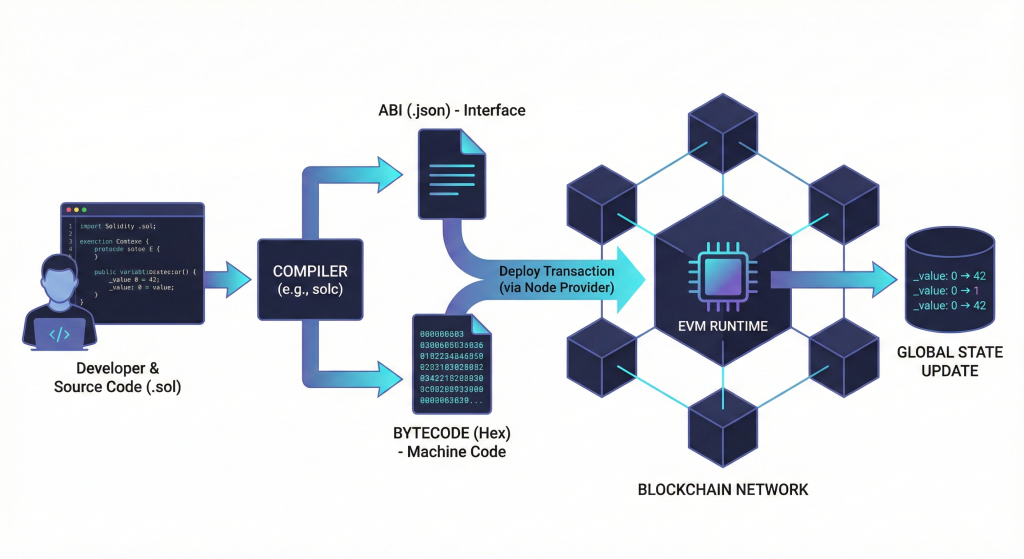
The EVM is the “brain” of Ethereum and many other EVM-compatible blockchains. It is a stack-based runtime environment where smart contract bytecode is executed.
Simplified EVM flow:
Solidity Code (.sol)
        ↓  [Compile]
Bytecode + ABI
        ↓  [Deploy Transaction]
Blockchain (EVM executes bytecode)
        ↓  [Interact]
User calls function → EVM processes → State changes
Key concepts when working with EVM:
- Gas: The “fee” for computation. Every opcode in the EVM has a specific gas cost. Gas optimization not only reduces expenses but also reflects developer expertise.
- ABI (Application Binary Interface): The contract’s interface definition — listing functions, parameters, and data types. It acts as the bridge allowing external applications to interact with the contract.
- Bytecode: The machine-level code that the EVM actually executes. When you write Solidity and compile it, bytecode is the final output.
One major advantage of EVM is its universality: write a contract once, deploy it on Ethereum, BNB Chain, Polygon, Arbitrum, Optimism, Avalanche, Base, and dozens of other EVM-compatible chains.
2. Essential Tooling
Before writing any code, prepare your toolkit.
2.1. Programming Languages
| Language | Description | When to use |
| Solidity | Most popular language for EVM, syntax similar to JavaScript/C++ | 95% of projects; largest ecosystem and documentation |
| Vyper | Alternative language with Python-like syntax, focused on simplicity and security | When prioritizing security-first design and auditability |
| Yul | Low-level EVM assembly language for maximum gas optimization | Inline assembly within Solidity for performance-critical sections |
In this post, we will use Solidity since it is the most widely adopted language with strong community support.
2.2. Node Provider
To interact with a blockchain, you need a node. Instead of running your own full node (which requires hundreds of GB of storage), you can use RPC providers such as:
- Alchemy: Great UI, strong documentation, enhanced APIs
- Infura: Industry veteran, highly stable
- QuickNode: High performance, supports many chains
- Ankr / Blast / Chainstack: Reliable alternatives
2.3. Wallet
MetaMask remains the most common choice for managing private keys and signing transactions during development.
However, in production or CI/CD environments, private keys should be managed through environment variables rather than browser extensions.
2.4. Block Explorer
Essential after deployment:
- Etherscan (Ethereum)
- BscScan (BNB Chain)
- Polygonscan (Polygon)
- Arbiscan (Arbitrum)
Block explorers allow you to verify source code, inspect transactions, and monitor contract state.
3. Development Framework – Choosing the Right “Weapon”
3.1. Hardhat
Hardhat
├── Config language: TypeScript
├── Testing: node:test (built into Node.js)
├── Web3 client: viem or ethers.js (plugin-based)
├── Plugin ecosystem: Extensive
└── Community: Largest currently
Strengths:
Hardhat v3 integrates tightly with TypeScript and uses viem as the default web3 client – providing type safety and high performance. Its plugin ecosystem is rich (hardhat-toolbox-viem, hardhat-ignition, hardhat-verify, etc.).
Best suited for:
Most projects, especially teams already comfortable with TypeScript.
3.2. Foundry
Foundry
├── Config language: Solidity (tests written in Solidity!)
├── Tools: forge (build/test), cast (interact), anvil (local node)
├── Speed: Extremely fast (written in Rust)
└── Testing: Built-in fuzz testing
Strengths:
Blazing fast compilation and testing. Tests are written directly in Solidity (no context switching to JS/TS). Built-in fuzz testing and invariant testing. Rapidly becoming the preferred choice among professional Solidity developers.
Best suited for:
Solidity-focused developers and performance-critical projects requiring advanced testing.
| Criteria | Hardhat | Foundry |
| Compile speed | Good | Very fast |
| Config language | TypeScript | TOML |
| Test language | TypeScript (node:test) | Solidity |
| Web3 client | viem / ethers | cast |
| Debugging | Traces + logs | Traces + verbose |
| Fuzz testing | Requires plugin | Built-in |
| Learning curve | Low (if familiar with TS) | Moderate |
| Ecosystem | Very large | Rapidly growing |
Recommendation
If you are just starting out, choose Hardhat.
If you want to go deep into professional Solidity development, learn Foundry.
Many teams today use both – Hardhat for scripting and deployment, Foundry for advanced testing.